
Part of our documentation is published in English.
- Framework of geospatial data standards for the Netherlands
When designing and developing a geographic information infrastructure, the challenge is always to choose the right set of standards. The Geospatial data standards Framework of geospatial data standards sets out the international and national standards that apply to the Netherlands within the geospatial domain for connection with other domains. The framework takes into account the connection to the European geographic information infrastructure and ensures the integration of the geographic information domain into the Dutch digital government.
- Survey of the Architecture of Ecosystems
Lead by the Chief Data Office of the ministry of Infrastructure and Water, ten data ecosystems have joined forces to survey the architecture of ecosystems.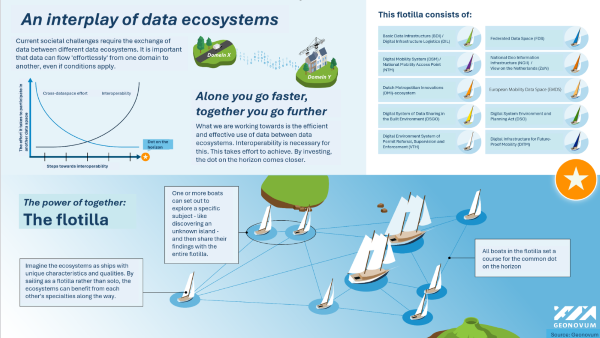
- Study: Policy Processes and Building Blocks for Digital Twins
The study Policy Processes and Building Blocks for Digital Twins provides a first step towards a common language between policy and technology for the creation and use of Digital Twins.
- Exploring interoperability of computation models and digital twins
To see if it is possible to make calculation models reusable and the results more comparable, we explored existing standards and what is needed to make models reusable. We discussed this 'interoperability' of calculation models with TNO, Wageningen University, Netherlands eScience Center, Deltares, Neelen and Schuurmans, Tygron, Netherlands Environmental Assessment Agency, ObjectVision, RIVM, KNAW-NIOZ, and Rijkswaterstaat. The results are presented in this report.
- Exploring data space initiatives
What is a data space? And what characterizes a data space? And how can we use and apply the data space as a concept in relation to the (national) spatial data infrastructure? These are the questions raised in this exploratory study. We provide insight into the underlying principles and concepts of data spaces from various data space initiatives that have emerged in recent years. We subject a number of data space initiatives to a quick-scan analysis and see which topics get attention and are important building blocks for data sharing in and across various domains.
- SCBA data space circular soils [English version]
In spatial challenges such as housing construction and dyke reinforcement, a significant amount of soils is released annually, ranging from clean and slightly contaminated soils and dredgings. There is an urgent need for insight into these released flows in order to reuse them in a high-quality way and to prevent unnecessary disposal.
The Buyer Group Grondstromen (a collaboration of Directorate-General for Public Works and Water Management, provinces, water boards and municipalities) has developed a market vision to accelerate more circular reuse of soils and dredgings. In this context, a national data space is being explored. This Social Cost-Benefit Analysis (SCBA) looks at the (one-time) investment and structural costs for setting up the data space for circular soil management in the Netherlands and the social benefits that can be expected as a result of putting the system into operation.